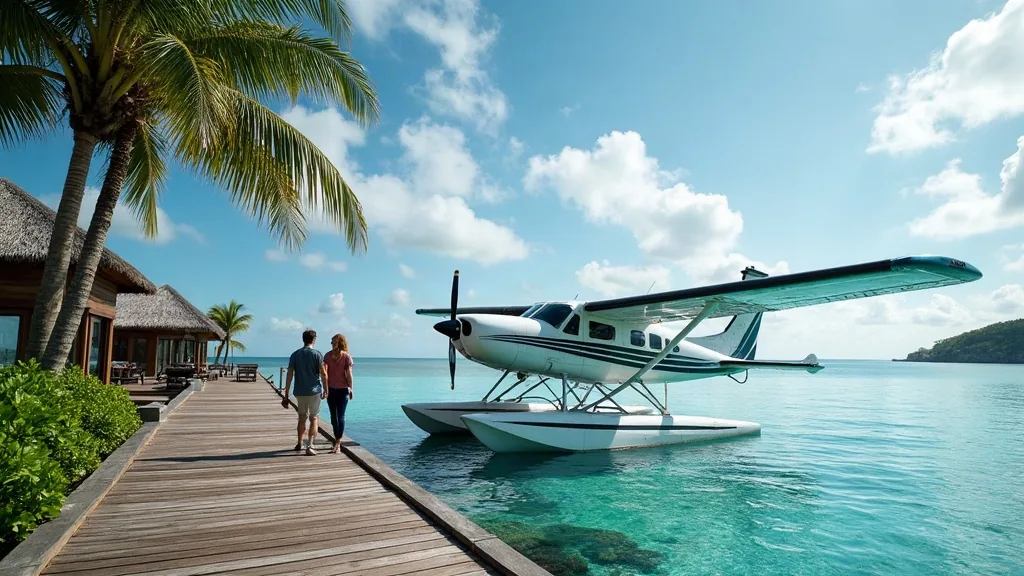
A resort seaplane charter programme is a standing arrangement in which Juara Holding Group’s coordination desk schedules whole-aircraft transfers for a resort’s guests between a hub airport or a certified water aerodrome and the resort’s approved landing zone, with dock handling, guest briefing and weather protocols agreed with a licensed Part 135 operator before the season starts.
Resorts use this kind of programme to move arriving and departing guests off congested road or boat routes, especially where the property sits on an island or a coastline with no paved runway. Juara Holding Group is an independent charter coordination desk, established in 2015, that arranges these transfers with licensed Indonesian operators — it does not own or operate aircraft. Every quote comes from a Civil Aviation Safety Regulations (CASR) Part 135 Air Operator Certificate (AOC) holder, since only AOC holders may legally fly commercial charters.
How does a programme work for the resort?
Resorts typically choose from three structures depending on guest volume and how far ahead arrivals are known.
| Structure | Best for | Lead time | Aircraft commitment |
|---|---|---|---|
| Ad-hoc guest charters | Low or irregular volume, VIP-only transfers | 48–72 hours per flight | Booked per flight, no standing slot |
| Blocked weekly slots | Steady mid-season occupancy | Confirmed weekly at season start | Recurring slot on a fixed day/time |
| Seasonal programme | High-season resorts with predictable waves | Locked before the season begins | Multi-week block with a named operator |
Ad-hoc charters give flexibility but the least price certainty. A seasonal programme locks capacity ahead of Indonesia’s dry season (April–November) or rainy season (October–March), tracked by BMKG’s Dry and Rainy Season Outlooks and ENSO/Indian Ocean Dipole monitoring, since these windows affect which routes and loads an operator will commit to months out. None of these structures is a guaranteed outcome; each stays subject to the operator’s scheduling and weather holds on the day.
Does the resort need its own water aerodrome?
Not necessarily, and a resort should never assume one can simply be built. Under the Directorate General of Civil Aviation (DGCA), a water aerodrome is regulated as an airport. DGCA’s Manual of Standard CASR Part 139 Volume III (Seaplane Bases/Waterbases), adapted from FAA Advisory Circular 150/5395-1, requires certification or registration under CASR sub-regulation 139.101, with shoreline boarding facilities certified under the same path. Keputusan Dirjen Perhubungan Udara KP 206 Tahun 2021 sets minimum technical specifications for water aerodromes serving seaplanes up to 30 seats.
A ministerial regulation enacted 22 August 2025 (State Gazette 2025 No. 620) defines an aerodrome water as the area used for seaplane arrivals, departures and movement, requires those operations to follow shipping-sector law, and obliges the organiser to coordinate with coastal radio stations and Vessel Traffic Services (VTS) units — a resort’s landing zone sits inside a regulated system shared with vessel traffic, not a private convenience.
Physically, DGCA standards call for a preferred water depth of 1.8 metres (1 metre for single-engine operations only), a required operating length that grows roughly 7 percent per 300 metres of elevation, and a taxi channel at least 45 metres wide with direct onshore access. DGCA records only two registered seaplane bases nationally, serving Cessna 208A Caravan and DHC-6 Twin Otter aircraft in 9-seat configurations. Research cites Bawah Island (Anambas) as an example of a certified luxury-island water aerodrome and Banyuwangi as positioned as a regional hub linking land and water operations — reference points only, never Juara Holding Group partners. Treat certification as a multi-agency process with no guaranteed approval.
What does the resort pay and what does the guest pay?
No published national seaplane charter rate, hourly figure or per-leg benchmark exists, so any number quoted is that operator’s own commercial decision — never a fixed tariff the desk can promise in advance. What a programme fixes in writing before the season is the payment structure, not the price:
| Element | Typically covered by | Notes |
|---|---|---|
| Standing slot / block reservation | Resort | Secures capacity for the period, independent of guest volume |
| Per-flight or per-seat charter cost | Resort, guest, or split | Confirmed per quote once route, aircraft and headcount are set |
| Fuel and positioning | Built into the operator’s quote | Jet A-1 pricing varies by base; a 2025–2026 bulletin lists AAP (Samarinda) at ~81.6 US cents/litre, AMQ (Ambon) at ~82.1 US cents/litre |
| Ground/dock handling at the resort | Resort | Marshalling, mooring and guest reception at the landing zone |
| Cancellation / weather-hold terms | Set by the operator’s contract | Confirmed in writing, never assumed |
Resorts usually either bundle the transfer into the guest package rate or bill it as a separate line item at booking. Either way, the figure is set by the AOC-holding operator once route and load are confirmed — the desk gathers quotes, it does not set or guarantee a price.
How are wet boarding, luggage and delays managed?
Guests typically transfer from a jetty or tender onto a floating dock or directly onto the aircraft’s float, so resorts brief guests in advance on footwear, luggage limits per seat, and a possible short wade at low tide. CASR Part 91 applies on the water: an aircraft must keep clear of vessels under right-of-way rules, and safety equipment scales with distance from shore — no take-off beyond 50 nautical miles from shore without a life preserver per occupant, and no flight beyond 30 minutes or 100 nautical miles without specified survival equipment, including life preservers with locator lights.
Delays run through the operator’s weather-hold protocol, coordinated with coastal radio stations and VTS units under the 2025 regulation. Written terms should specify who informs the resort of a hold, how a missed connection is re-booked, and whether a blocked slot rolls to the next window. Seaplane operations stay weather-dependent, so guest communication should say so rather than promise an on-time transfer.
How booking works
- Brief the desk. Resort GM or ops manager sends guest volume, arrival dates, hub airport and preferred landing zone to bd@juaraholding.com.
- Compare operator quotes. The desk gathers structure and terms from licensed Part 135 AOC holders — ad-hoc, weekly block or seasonal.
- Confirm certification status. If the resort’s own landing zone is involved, its CASR 139 Vol III status is checked before any slot is locked.
- Sign programme terms. Payment structure, cancellation and weather-hold terms go in writing directly with the chosen operator.
- Season live. The desk coordinates scheduling and guest-briefing logistics for the agreed period, flight by flight.
Talk to the programme desk. Resort GMs comparing charter structures for an upcoming season: bd@juaraholding.com or WhatsApp 6281139414563. Juara Holding Group is an independent coordination desk, not an aircraft operator — every figure quoted comes from a licensed Part 135 AOC holder, never a guaranteed rate or a promise of water aerodrome approval.
Frequently Asked Questions
Can a resort charter a seaplane without owning a water aerodrome?
Yes. Most programmes route guests through an existing hub airport or an already-certified water aerodrome rather than building a new one. A resort only needs its own certified landing zone for direct guest arrival at the property, which requires separate CASR 139 Vol III registration.
How far in advance should a resort book a seasonal seaplane programme?
Operators want commitments locked before the relevant BMKG-tracked season begins — ahead of the April–November dry season or the October–March rainy season — since aircraft and crew scheduling firms up months out. Ad-hoc single charters can often be arranged with 48–72 hours’ notice instead.
What happens if weather cancels a scheduled resort transfer?
The operator’s weather-hold protocol applies, coordinated with coastal radio stations and Vessel Traffic Services units under the 2025 water aerodrome regulation. A written programme should specify who notifies the resort, how guests are re-booked, and whether the missed slot rolls forward — not a guaranteed same-day resolution.
Can multiple resorts share one seaplane charter programme?
Some operators allow a shared blocked slot across nearby properties to improve load factors, negotiated case by case with the AOC holder depending on route overlap and guest volume. It is not a standard feature the desk can promise in advance.
Is Juara Holding Group the seaplane operator for resort charters?
No. Juara Holding Group is an independent charter coordination desk established in 2015. It arranges resort programmes with licensed Indonesian Part 135 AOC holders and is not affiliated with any named operator, aircraft owner or water aerodrome.