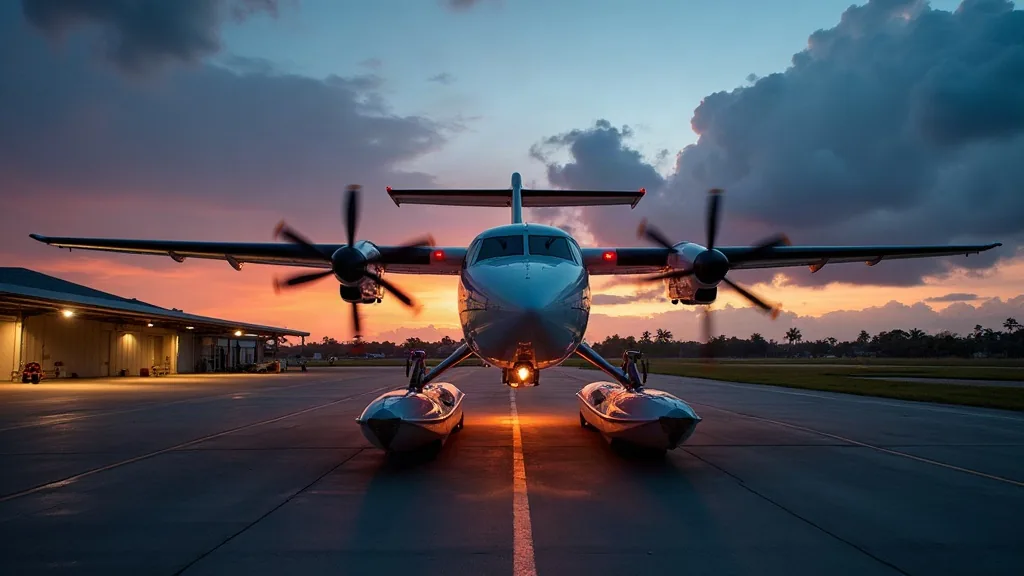
Nationwide seaplane charter in Indonesia means booking the whole aircraft, not a seat, for a private flight between any two approved water aerodromes or an airport-to-water pairing, arranged through a desk that only uses Indonesian CASR Part 135 Air Operator Certificate holders, because foreign carriers cannot fly a domestic leg under Aviation Law No. 1 of 2009.
This page is the starting point for anyone planning a private seaplane movement anywhere in Indonesia — one desk, one point of contact, one invoice, regardless of which islands or water aerodromes are involved. Route-by-route detail for a specific region (Bali departures, Komodo, Raja Ampat, Lombok, Derawan and others) lives on the dedicated site for that region, and the online booking mechanics for a confirmed itinerary sit with bookseaplane.com. What follows is the regulatory picture, the charter formats available, how a quote is built, and what a coordination desk actually does.
What rules govern seaplane charter in Indonesia?
Indonesia’s Directorate General of Civil Aviation (DGCA), under the Ministry of Transportation, adopted seaplane-base standards from FAA Advisory Circular 150/5395-1 and published them domestically as the Manual of Standard CASR Part 139 Volume III, Seaplane Bases (Waterbases). Keputusan Direktur Jenderal Perhubungan Udara Nomor KP 206 Tahun 2021 sets the minimum technical and operational specifications for water aerodromes handling seaplanes of up to 30 seats, and a water aerodrome is certified or registered as an airport under CASR 139 sub-regulation 139.101, with shoreline facilities held to the same standard.
A ministerial regulation enacted 22 August 2025 (State Gazette 2025 No. 620) formally defines an “aerodrome water” as the water area used for seaplane arrival, departure and movement. It requires seaplane operations on water to follow shipping-sector law and obliges every water aerodrome organiser to coordinate with coastal radio stations and Vessel Traffic Services (VTS) units before and during movements — a maritime-aviation overlap that does not exist at a conventional land airport.
In the air, CASR Part 91 requires an aircraft operating on water to keep clear of vessels and give way under standard right-of-way rules. A seaplane may not depart on a flight more than 50 nautical miles from shore without a life preserver or approved flotation device for every occupant, and may not fly more than 30 minutes or 100 nautical miles from shore without specified survival equipment, including life preservers fitted with locator lights. Commercially, only a holder of a valid CASR Part 135 Air Operator Certificate may conduct a charter flight, and that same certificate governs which operator a desk is legally able to place a booking with.
Which charter formats exist?
Nationwide charter covers several distinct use cases. Each has its own booking lead time, aircraft sizing logic and pricing shape:
| Format | Typical use | What decides the price |
|---|---|---|
| On-demand point-to-point | A single private leg between two approved sites on a date you choose | Sector distance, aircraft type, one-way vs. return |
| Multi-day island hopping | A private itinerary across several water aerodromes over consecutive days | Number of legs, standby days, overnight positioning |
| Corporate charter | Executive movement for a company, often repeat bookings | Group size, schedule flexibility, invoicing terms |
| Production charter | Film, photography or media crews needing air-to-air or repositioning flights | Crew and equipment weight, flight duration, permits |
| Resort charter programme | A recurring transfer arrangement for a single resort’s guests | Volume, seasonality, dedicated slot agreements |
| Empty leg | A positioning flight sold at short notice by the Part 135 AOC holder operating it | Fixed by the operator; sold as the whole aircraft, never as individual tickets |
Empty-leg availability is real but narrow: DGCA guidance is explicit that only Part 135 AOC holders may market these flights, that they must be sold as the entire aircraft on a predetermined route and time, and that selling individual seats on an empty leg is not permitted. A desk can flag genuine empty-leg windows as they appear, not guarantee them on any given date.
How does pricing build up?
No official national benchmark exists for seaplane charter rates in Indonesia — hourly, per-leg or per-day — so any figure quoted to you is a specific operator’s commercial decision for that aircraft, route and date, never a published tariff. What consistently moves the number is this:
| Component | Why it matters |
|---|---|
| Aircraft type | The two seaplane types most commonly recorded against Indonesia’s registered water aerodromes, the Cessna 208A Caravan and the DHC-6 Twin Otter, both fly in nine-seat passenger configuration, and larger or smaller loads change the aircraft required |
| Sector length and flight time | Longer over-water sectors trigger the CASR 91 flotation and survival-equipment thresholds at 50 NM and 100 NM from shore |
| Positioning | If the aircraft is not already based near your departure point, a repositioning leg is added to the quote |
| Ground handling and permits | Water aerodrome coordination with coastal radio and VTS units, plus any site-specific landing approval, is arranged per leg |
| Season and demand | Peak dry-season weeks and holiday periods compress aircraft availability |
A quote request that specifies dates, sector, passenger count and aircraft preference up front returns a firmer number faster than an open-ended enquiry.
Which months work best per region?
BMKG (Badan Meteorologi, Klimatologi, dan Geofisika) describes Indonesia’s rainy season as generally running October through March and the dry season as generally running April through November, driven by monsoon winds moving from Australia toward Asia. BMKG publishes Dry Season and Rainy Season Outlooks, tracks ENSO and Indian Ocean Dipole conditions, and issues monthly rainfall and rain-character analyses — its July 2026 rainfall analysis is one recent example — that feed into charter-date planning at a regional level. Because water-landing conditions vary by site and by year, a coordination desk cross-checks the current BMKG outlook against your preferred dates rather than relying on the general seasonal pattern alone.
What does a desk do that an operator does not?
An individual Part 135 operator flies its own aircraft on its own base. A nationwide coordination desk sits above that layer: it compares aircraft and availability across multiple licensed operators for your specific route, handles the water aerodrome and VTS coordination steps that sit outside a standard flight booking, consolidates a multi-leg or multi-operator itinerary into one invoice, and manages rebooking if weather or aircraft availability changes a date. Juara Holding Group operates as an independent charter coordination desk, established 2015, arranging flights with licensed Indonesian operators — it is not an aircraft operator itself and is not affiliated with any named operator referenced on this site.
What should you prepare for a quote?
- Preferred travel dates and a backup date window
- Departure and arrival points (named water aerodrome, airport, or resort/vessel rendezvous)
- Passenger count and total baggage or equipment weight
- Charter format needed (on-demand, multi-day, corporate, production, resort programme)
- Any production, filming or special-equipment requirements
- Onward connection details if the charter links to a liveaboard, resort stay or airport transfer
How booking works
- Send your brief — dates, route, passenger count and format to the desk by WhatsApp or email.
- Receive operator options — the desk checks Part 135 AOC holders with suitable aircraft and returns available slots and an indicative quote.
- Confirm the itinerary — once you approve a slot, the desk locks the aircraft and coordinates water aerodrome and VTS clearance for each leg.
- Fly — you receive a single confirmation covering every leg of a multi-day or multi-operator itinerary.
- Handle changes through one contact — weather holds or rescheduling go through the desk, not through separate calls to each operator.
For the actual reservation form and payment step, use bookseaplane.com; this desk is for routing, sourcing and coordinating the charter itself.
Ready to request a nationwide charter? Message the Juara Holding Group concierge desk on WhatsApp at 6281139414563 or email bd@juaraholding.com with your dates, route and passenger count. As an independent coordination desk, Juara Holding Group is not an aircraft operator and arranges every flight through licensed Indonesian Part 135 AOC holders.
Frequently Asked Questions
Can a foreign-registered seaplane operator fly me between two Indonesian islands?
No. Aviation Law No. 1 of 2009 prohibits foreign carriers from carrying passengers between two points inside Indonesia, and the Transportation Ministry has confirmed that routing a domestic leg indirectly through an online travel agent does not get around this. Every domestic seaplane charter leg, including nationwide multi-stop itineraries, must be flown by an Indonesian CASR Part 135 Air Operator Certificate holder.
What is the difference between booking directly with a seaplane operator and using a coordination desk?
A single operator can only offer its own aircraft, base and schedule. A coordination desk compares availability across multiple licensed Part 135 operators for your specific route, handles water aerodrome and VTS coordination on your behalf, and issues one invoice for a multi-leg itinerary instead of separate bookings and payments with each operator involved.
Are empty-leg seaplane charters genuinely available in Indonesia?
Occasionally. DGCA guidance permits Part 135 AOC holders to market a positioning flight as an empty leg, sold as the entire aircraft on a fixed route and time — never as individual seats. A desk can alert you to a genuine empty-leg window as one appears, but availability is short-notice and cannot be guaranteed for a specific date.
Do I need special approval to land a chartered seaplane at a resort or private beach?
Yes, in principle: a water aerodrome is certified or registered under CASR 139 sub-regulation 139.101, and since the 22 August 2025 regulation, its organiser must coordinate with coastal radio stations and Vessel Traffic Services units for each movement. The operator and desk handle this coordination as part of arranging the charter; it is not something a passenger files directly.
How far in advance should I submit a nationwide charter request?
There is no fixed rule, but a request that includes firm or near-firm dates, exact departure and arrival points, passenger count and preferred aircraft type returns a workable quote fastest. Multi-day, multi-operator or production charters benefit from more lead time because they involve coordinating aircraft availability, ground handling and water aerodrome clearance across several stops at once.